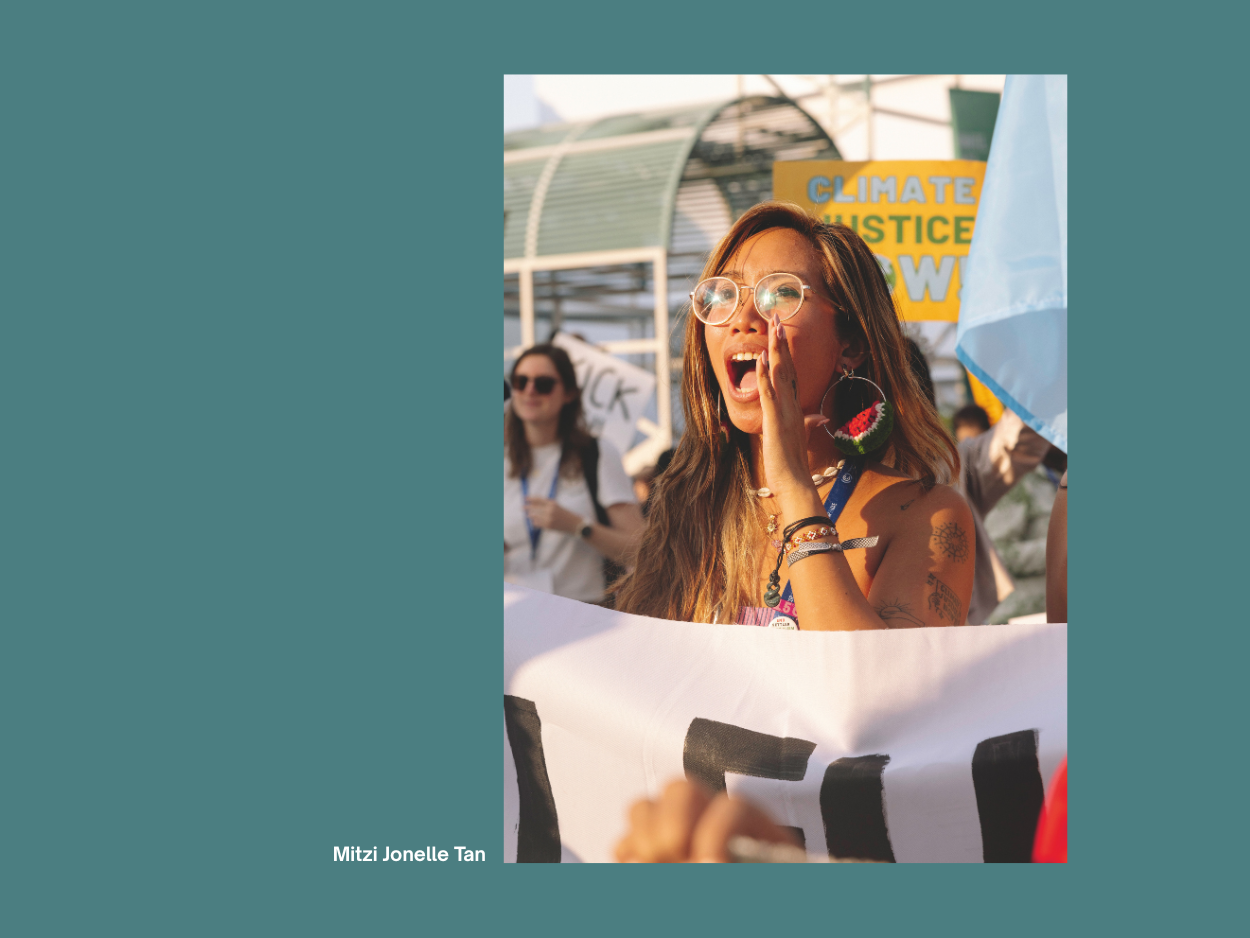
Global societal power relations are reflected in everyday life. In her third column, MITZI JONELLE TAN talks about her role models and how they open up new perspectives for the fight for climate justice.
Three years ago, a small group of 20 young people joined a community immersion event organized by Youth Advocates for Climate Action Philippines. We spent two days in a coastal community in Noveleta, Cavite, Philippines, to understand the struggles of our small fisherfolk and how their fight intersects with the fight for climate justice.
In the scorching heat of a makeshift shed, we listened to the stories of Ariana Soledad, a trans woman fisherfolk, environmental defender, and community organizer with PAMALAKAYA, a national federation of fishing organisations in the Philippines. She talked about the increasing impacts of the climate crisis on fishing communities, the added struggle of so-called development projects like reclamation projects, and the pressure on their livelihoods by large-scale fishing boats. Her work as a community organizer, her fight for the rights of fisherfolk and the oceans, had led to threats to her life and safety from state forces. However, she keeps on fighting. When I asked her how she finds the strength and hope to keep going, she said very simply: “Mahal ka ng masa, lagi kang kukupkupin ng masa.” (The masses love you, they will always embrace and take care of you).
Nanay, mother
She told us about how fisherfolk are often scared or apprehensive of activists because of how police or military tag activists as terrorists. Only through deep organizing and relationship building over time do they realize that you’re on their side. From there, they will house you, feed you, and welcome you, and welcome anyone that you welcome to their community as well. This is the treatment that I have always felt when visiting communities of environmental defenders in the Philippines. Whether small farming communities, Indigenous communities, or small fisherfolk communities, if they see that the community organizers and leaders trust you, they will trust you too and accept you wholeheartedly. These communities are often led by strong women that are called “nanay” or “mother.”
They lead their communities, not through force or strict rules, but with nurture and care. One of them was Nanay Carmen. She took us into her home, where five of us slept squeezed into her and her husband’s makeshift bed (with Tatay Ed, her husband, sleeping on a bench). It was the first time we ever met, but she was happy that young activists were curious to learn how they were campaigning for their rights as fisherfolk.
The coldness of white society
I’ve moved to Berlin now, far from the warm embrace of both the Philippine heat and Nanay Carmen, Ariana, and the Filipino masses. The coldness of the weather is matched only by the coldness of this white society. Within Western white societies, the pressures of the capitalist system to individualize run strong and deep. I enter a room, and I’m immediately marked as different, an outlier, an outsider. I am pushed aside, bumped into – unseen or seen only as an obstacle. Even within feminist and justice-oriented spaces, I’ve learned not to feel safe. The weight seeps into my body before I even recognize the thoughts running in my head. Immediately, I scan the room to find a face that would understand. If I say something, would they believe me? If a microaggression happens, would someone else catch it? Would someone else validate the panic and fear that runs through my body in a split second that I myself can’t put into words? That I myself don’t understand?
A reflection of society
Now, the fishing community was nowhere near perfect. In the middle of the night, many of us woke up to furious screaming – a violent fight was happening next door between a seemingly drunk husband and his wife. It was jarring and shocking, with one of the youth saying she couldn’t handle it and deciding to go home immediately. Even within communities that are being organized by activists, gender-based violence continues.
I asked Nanay Carmen and Ariana what they do about it, and how they stay hopeful despite both the threats of military and state forces and the difficulty of their own community members being violent to women. They told me something that I initially thought was so simple, but over time, I really understood better: They are a reflection of the wider society, and we live in a patriarchal, colonized, macho-feudal society. It’s scary, but if we don’t continue organizing and political education, it won’t get better. Part of our work is also to awaken our community members’ political consciousness. We do this so they not only fight for fisherfolks’ rights, but for the rights of all those oppressed in the Philippines, including women.
We talk to the men and show them the parallels of their violence at home with the violence of the state forces or the state and corporations’ projects destroying their livelihoods. They listen because we have built a relationship with them, and they see that we care. It’s a slow process, but things are changing. They talked not of hope, but of love and care. Love and care that didn’t shy away from calling out injustices, but love and care so fierce that it did not back down from confrontation.
The warmth – and the love
Faced with the whiteness I experience in Berlin, I remember Nanay Carmen and Ariana’s words: they are a reflection of the wider society. In Black Skin, White Masks, Frantz Fanon reminds us that every colonialist entity is a racist one. The ruling class of Germany had to turn its society into a racist society to justify its colonization of other countries, and this has stayed deeply ingrained in every part of Germany and every white society. It’s the same rotten root that has allowed Trump to rise in the U.S., where he now captures the president of another country because he believes the country needs to be “run properly.” It is the same logic that allows the majority of the world to be turned into a sacrifice zone to the climate crisis, for the profit of the richest.
From the personal to the national to the global level, those oppressed see and experience a harsh reality, and those with privilege or power are saying, this is normal. I take refuge in the memory that this is not the only way. I have felt the most warmth amongst people who had every reason to be cold. Despite my hope flickering, I know now that love embraces me. I hope to one day have the grace and steadfastness that Ariana and Nanay Carmen have in the face of larger-than-life threats, but for now, let love be enough.
Mitzi Jonelle Tan is a writer, climate justice activist, and organizer from Metro Manila, Philippines. She is Global Coordinator with the Fossil Fuel Non-Proliferation Treaty Initiative, the Project Lead of the Climate Justice Squad Fellowship, and a member of Gabriela Germany – the German chapter of Gabriela, an anti-imperialist gender justice alliance in the Philippines.